The Crave Copyright Lawsuit Reveals a Disturbing Trend
Tracy Wolff is innocent of plagiarism, but there's a bigger problem.

Ellie Blackwood
March 24, 2026
Hi bookish friends! In today’s newsletter, I’m covering what we know about Netflix’s cancelled Six of Crows TV show and a short spoiler-free review of the War Between the Land and the Sea miniseries. But first, this month gave us the resolution to one of the most infamous copyright lawsuits in fantasy fiction.
What Were the Accusations Against Tracy Wolff?
In 2022, unpublished writer Lynne Freeman sued bestselling author Tracy Wolff, along with Wolff’s agent and publisher, accusing them of copyright infringement. Freeman claimed that Wolff’s bestselling YA paranormal fantasy romance series, Crave, was a ripoff of a manuscript she had written in 2010, called Blue Moon Rising.
Wolff denied ever having read Blue Moon Rising. However, Wolff’s literary agent was also Freeman’s former agent, who had read several copies of the Blue Moon Rising manuscript before she and Freeman parted ways in 2014. Furthermore, Blue Moon Rising had at one point been submitted to the same publisher that released Crave.

The Crave series by Tracy Wolff.
Unlike with most traditional publishing deals, where authors do all the actual writing and publishers just provide notes and copyedits, the process of writing Crave was heavily guided by the publisher from the start. The publisher’s CEO developed the idea for the series, collaborated with Wolff to create the outline, and even helped write some actual scenes in the books. Freeman alleged that her former agent and the publisher must have stolen the Blue Moon Rising manuscript and used it to help write Crave.
Some of the similarities Freeman claimed between the stories were quite specific, such as the protagonist moving from San Diego to Alaska. However, others were common paranormal romance and fantasy tropes, such as the protagonist falling in love with a sexy paranormal creature, finding out she’s a unique supernatural being, and getting drawn into a magical war.
The whole debacle first came to my attention thanks to a 2025 article in the New Yorker, called “Did a Best-Selling Romantasy Novelist Steal Another Writer’s Story?” Well, according to a ruling by the judge in the case this last week, the answer is an emphatic “No.” (Betteridge’s Law of Headlines strikes again.)
The Verdict in the Crave Lawsuit
On March 16, 2026, Judge Colleen McMahon released a sweeping 157-page opinion exonerating Wolff and her team of plagiarism. In making her ruling, McMahon assumed that Wolff and her team could have reasonably had access to the Blue Moon Rising manuscript, but it didn’t matter anyway because the works were not substantially similar.
The judge read all six major drafts of Blue Moon Rising, as well as the first four Crave books, to come to a decision. She determined that, while there were some parallels between the works, all of the similarities were either common paranormal romance tropes or random scattered details that weren’t central to the story and couldn’t be copyrighted.

Headshot of Tracy Wolff.
In a post on her Instagram, Wolff wrote, “Plagiarism/copyright infringement is a serious thing, and it's something I've stood against my entire career — as an English teacher and professor, and as a writer. The Court's decision is full vindication of what I have maintained all along: I did not do what I was accused of, nor would I ever.”
Some litigation in this case is still ongoing, because in 2025, Freeman filed another copyright lawsuit against the fifth and sixth books in the Crave series, which were published after she filed her initial lawsuit in 2022. However, the verdict in this first case is a pretty big blow to Freeman’s chances of victory in the second case, and it’s possible that the rest of the litigation could be resolved fairly quickly in favor of Wolff and her team.
What The Freeman v. Wolff Case Reveals
This particular story is shaping up to be a happily ever after for Tracy Wolff. However, this is by far the first time that an author has accused another author in the same genre of copyright infringement, only to find their accusations didn’t hold up in court. Even if the defendant is eventually found innocent, these kinds of cases take a huge toll on people’s wallets and their mental health.
The fact is, proving copyright infringement is very difficult unless someone literally copied and pasted large passages of someone else’s work into their own. Ideas and tropes cannot be copyrighted — only a particular expression of them can. That doesn’t stop some authors from trying to win a case on more nebulous grounds, though.
Watch Early: The Twisted World of Paranormal Romance Plagiarism Scandals
You’ve now heard of Lynne Freeman v. Tracy Wolff. You may (or may not) have also heard of Sherrilyn Kenyon v. Cassandra Clare, or Addison Cain v. Zoey Ellis. All three of these notorious lawsuits revolve around accusations of copyright infringement for books in the paranormal romance-adjacent space.
So is there a reason why the paranormal romance genre might be especially prone to copyright lawsuits? My newest YouTube video essay dives into each of these three cases, detailing the accusations and how they were resolved in court. In the end, I attempt to develop a theory about why this keeps happening in paranormal romance.
This video will be available to the public in a few days’ time, but email subscribers get to watch it early at this unlisted link!
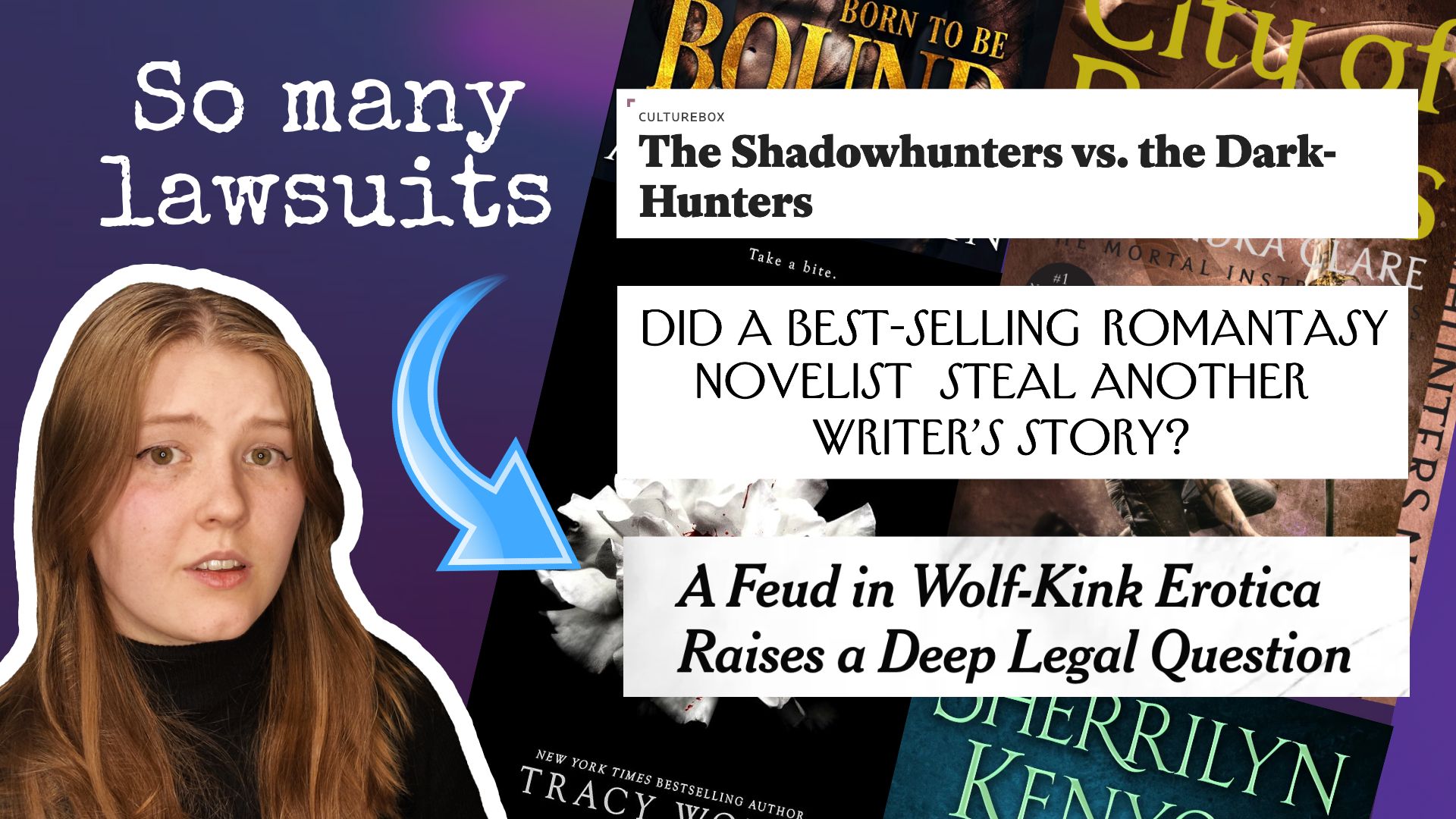
The thumbnail for my new YouTube video essay.
Everything We Know About the Cancelled Six of Crows Netflix Show
In 2023, Netflix announced the cancellation of its Shadow and Bone TV adaptation, killing fans’ hopes that the streamer might create a spinoff show covering the events of the highly acclaimed Six of Crows books. But did you know that the Six of Crows spinoff show was surprisingly close to becoming a reality?
I created a three-minute video for YouTube Shorts, Instagram, and TikTok that breaks down the tidbits the writers have revealed about the development for the Six of Crows show. (This short was edited from my long video essay about the downfall of the Shadow and Bone show.)
Spoiler-Free Thoughts on The War Between the Land and the Sea
The latest Doctor Who spinoff, The War Between the Land and the Sea, might still only be available on BBC iPlayer, but it has been attracting a fair amount of attention thanks to clips posted on TikTok. I posted my long review of the show on YouTube in January, but I also cut down a 3-minute spoiler-free review for release on Instagram and TikTok:

Thank you so much for reading! Until next time, bookish friends.
Love,
Ellie
Reply